
This column examines the macroeconomic effects of defense spending shocks, with a focus on emerging and developing economies. Using cyclically adjusted defense shocks and a local projections framework for a global sample over the period 1990 to 2023, we estimate that defense shocks yield modest but persistent effects on output, with multipliers of around 0.7% to 1% after 8 years. The magnitudes are higher for economies where defense outlay spillovers are more labor- rather than capital-intensive. Multipliers are also highly state-dependent, with fiscal space, revenue capacity, financial development, institutional quality shaping their size and persistence. For central banks, rising defense spending also has implications for the conduct of monetary policy. Where defense expansions generate persistent demand pressures, particularly in economies with limited fiscal space or already elevated inflation, monetary authorities need to carefully assess whether the resulting stimulus is consistent with price stability.
Defense spending has long occupied a contested space in economic policy. On one side, Keynesian perspectives emphasize its potential to stimulate demand and output, especially in economies facing cyclical downturns (Ramey, 2011; Batini et al., 2014). On the other, classical and endogenous growth arguments stress the risks of crowding out: military outlays may divert resources away from more productive investments in infrastructure, education, or health, thereby undermining long-term growth prospects (Barro, 1991; Dunne and Tian, 2015). For emerging markets and developing economies (EMDEs), where fiscal space is often constrained and external vulnerabilities high, the trade-offs are particularly acute. These tensions are further amplified in environments exposed to elevated geopolitical risk and active conflict, where security considerations may dominate traditional growth–efficiency trade-offs.
Recent trends highlight the urgency of reassessing these questions. According to the Stockholm International Peace Research Institute (SIPRI), global military expenditure reached a record $2.4 trillion in 2023, with EMDEs in Asia accounting for over one-third of the increase (SIPRI, 2024). In addition, defense budgets are rising faster and more persistently in Asia compared to other EMDE regions, reflecting both heightened geopolitical risks and domestic political priorities. The economic implications are unclear. Some argue that ramping up defense spending can boost output in the short run by mobilizing idle resources (Benoit, 1978; Kollias et al., 2004). Others caution that such spending is capital-intensive, less labor-absorbing, and yields limited spillovers, thereby generating smaller multipliers than investment in infrastructure, education, or health (Gupta et al., 2001; Deger and Sen, 1995).
For EMDEs where developmental needs remain pressing and fiscal buffers uneven, the central policy question is whether higher defense outlays provide macroeconomic stimulus or instead crowd out more productive investment. This trade-off between short-run stimulus and medium-term displacement is therefore at the heart of the policy debate surrounding defense spending in EMDEs. Unlike infrastructure, health, or education outlays, military expenditure is rarely justified on growth grounds alone. Its macroeconomic effects must therefore be evaluated primarily through the lens of opportunity costs—namely, whether defense shocks crowd in private activity through demand spillovers or crowd out more productive forms of public and private investment.
Our recent paper addresses that question by estimating defense spending multipliers in EMDEs, with a particular focus on Asia and the Pacific (Jalles, Beirne, and Park, 2026). Using the United Nations’ Classification of the Functions of Government (COFOG) to identify military expenditure as a share of GDP, we construct cyclically adjusted defense spending shocks following country-specific output elasticities. Exogenous shocks are defined as large increases—exceeding one standard deviation above historical means—thus capturing discretionary policy changes rather than automatic stabilizers. We then employ the local projections framework of Jordà (2005) to estimate impulse responses of output, investment, and external balances. We augment this framework to incorporate both conflict-based geopolitical risk and regional spillover channels.
The findings show that defense shocks in EMDEs produce positive and persistent output effects, with multipliers reaching around 0.7%–1% after 8 years, while advanced economies experience weak or even negative responses (Figure 1).
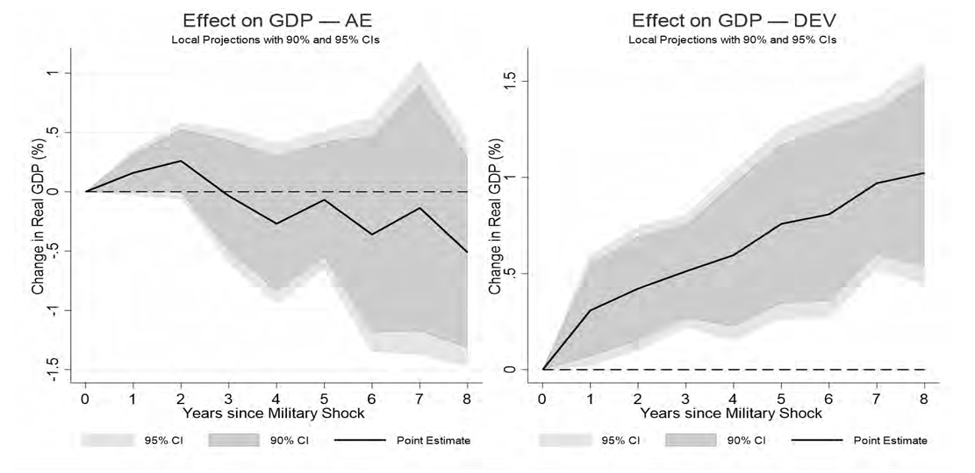
Figure 1. Effect of Defense Spending Shocks on GDP
Notes: AE = advanced economies, CI = confidence interval, DEV = emerging markets and developing economies, GDP = gross domestic product. Note: Defense spending shocks are identified as binary events using the Hodrick–Prescott filter to cyclically adjust expenditure. The solid black lines plot the impulse responses of real GDP to defense shocks, with year = 1 denoting the first year after the shock. Results are shown separately for advanced economies (AE, left panel) and emerging markets and developing economies (DEV, right panel). Dark grey shaded areas denote 90% spatial correlation consistent (SCC) confidence bands; light grey shaded areas denote 95% SCC confidence bands.
Source: Jalles, Beirne, and Park (2026).
State dependent analysis further shows that fiscal space, trade openness, financial development, revenue capacity, and institutional quality strongly shape the size and persistence of multipliers. Notably, multipliers are stronger and more persistent where debt is low or where financial development is high (Figure 2).
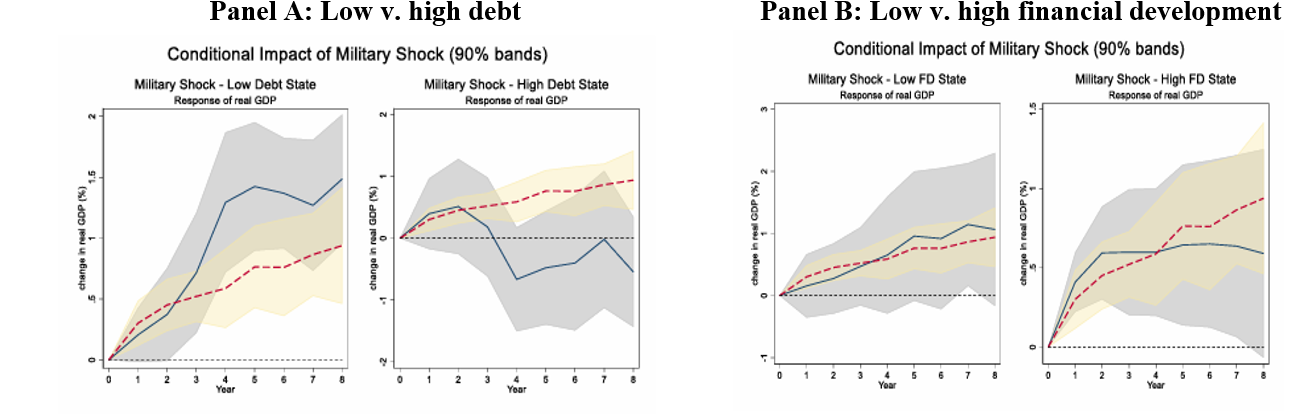
Figure 2. Conditional Local Projections: Effects of Defense Spending Shocks
Notes: FD = financial development, GDP = gross domestic product.
Binary-created shocks using the Hodrick–Prescott filter to cyclically adjust the respective variables. Year = 1 is the first year after a shock took place at year = 0. The solid blue lines plot the conditional impulse responses of military shocks on real GDP, while the dashed red line represents the unconditional baseline response. The dark grey shaded areas correspond to 90% spatial correlation consistent (SCC) confidence bands around the conditional responses, and the yellow shaded areas depict 90% SCC confidence bands around the unconditional response.
Source: Jalles, Beirne, and Park (2026).
We also find that within EMDEs, South Asia displays strong and sustained gains, whereas East Asia exhibits muted effects due to the capital-intensive nature of defense procurement. Functional decomposition reveals that only core military spending and defense-related R&D contribute positively to growth, while civil defense and foreign aid exert no significant effects. Crucially, defense spending is substantially more expansionary in high conflict environments, while regional defense shocks generate only weak short-run spillovers and negative medium-run effects. Taken together, the evidence indicates that the macroeconomic impact of defense spending is neither universally expansionary nor contractionary, but highly conditional on country circumstances and spending composition.
The results have several policy implications. Defense spending should not be regarded as a blanket tool for macroeconomic stabilization. Where fiscal space is ample and credit markets deep, defense outlays can deliver temporary stimulus, particularly when directed toward innovation and R&D. In contrast, countries with high debt, fragile revenue capacity, or open economies see little return from additional defense spending. Policymakers in EMDEs must therefore weigh the opportunity costs: reallocating resources toward infrastructure, health, or education may yield larger and more inclusive long-term gains. Still, in environments where security pressures necessitate higher defense budgets, governments can design them to maximize economic spillovers, for example by prioritizing defense-linked innovation. At the same time, our spillover results caution that regional defense buildups offer little sustained stimulus and may generate negative medium-run effects through crowding out and competitive reallocation across neighboring economies.
For policymakers, the central lesson is that context matters: under the right circumstances, defense outlays can provide a short-term boost, but absent favorable conditions they risk straining scarce resources, crowding out more productive investments, and generating adverse spillovers at the regional level over the medium run. Policymakers need to therefore weigh the opportunity costs: reallocating resources toward infrastructure, health, or education could yield larger and more inclusive long-term gains.
For central banks, rising defense spending also has implications for the conduct of monetary policy. Where defense expansions generate persistent demand pressures, particularly in economies with limited fiscal space or already elevated inflation, monetary authorities need to carefully assess whether the resulting stimulus is consistent with price stability. At the same time, the strong state dependence of defense multipliers suggests that monetary policy should account for countries’ fiscal and financial conditions when evaluating the macroeconomic consequences of sustained increases in defense expenditure.
Furthermore, the escalation of defense spending raises the risk of fiscal dominance, especially in light of already record-high public debt levels around the world. The independence of central banks to fight inflation may be seriously compromised if they prioritize the government’s financing needs. More specifically, central banks may be forced to absorb government bonds or keep interest rates artificially low, eventually resulting in higher inflation. Central bank independence as a key pillar of macroeconomic stability thus assumes even greater importance.
References
Auerbach, Alan J., and Yuriy Gorodnichenko. 2013. “Fiscal Multipliers in Recession and Expansion.” In Fiscal Policy after the Financial Crisis, edited by Alberto Alesina and Francesco Giavazzi, 63–98. Chicago: University of Chicago Press.
Barro, Robert J. 1991. “Economic Growth in a Cross Section of Countries.” Quarterly Journal of Economics 106 (2): 407–443.
Batini, Nicoletta, Giovanni Callegari, and Giovanni Melina. 2014. “Successful Austerity in the United States, Europe, and Japan.” IMF Working Paper No. 14/56.
Benoit, Emile. 1978. “Growth and Defense in Developing Countries.” Economic Development and Cultural Change 26 (2): 271–280.
Deger, Saadet, and Somnath Sen. 1995. “Military Expenditure and Developing Countries.” In Handbook of Defense Economics, Vol. 1, edited by Keith Hartley and Todd Sandler, 275307. Amsterdam: Elsevier.
Dunne, J. Paul, and Nan Tian. 2015. “Military Expenditure and Economic Growth: A Survey.” Economics of Peace and Security Journal 10 (1): 15–30.
Gupta, Sanjeev, Benedict Clements, Rina Bhattacharya, and Shamit Chakravarti. 2004. “Fiscal Consequences of Armed Conflict and Terrorism in Low- and Middle-Income Countries.” European Journal of Political Economy 20 (2): 403–421.
Ilzetzki, Ethan, Enrique G. Mendoza, and Carlos A. Végh. 2013. “How Big (Small?) Are Fiscal Multipliers?” Journal of Monetary Economics 60 (2): 239–254.
IMF. 2021. World Economic Outlook. Washington, DC: International Monetary Fund.
Jalles, T. Joao, John Beirne, and Donghyun Park. 2026. “Bullets and budgets: Measuring defense spending multipliers”, Defence and Peace Economics, forthcoming.
Jordà, Òscar. 2005. “Estimation and Inference of Impulse Responses by Local Projections.” American Economic Review 95 (1): 161–182.
Kollias, Christos, George Manolas, and Suzanna-Maria Paleologou. 2004. “Defense Spending and Economic Growth in the European Union.” Journal of Development Economics 74 (1): 211–231.
Ramey, Valerie A. 2011. “Identifying Government Spending Shocks: It’s All in the Timing.” Quarterly Journal of Economics 126 (1): 1–50.
Ramey, Valerie A. 2019. “Ten Years after the Financial Crisis: What Have We Learned from the Renaissance in Fiscal Research?” Journal of Economic Perspectives 33 (2): 89–114.
SIPRI. 2024. Trends in World Military Expenditure 2023. Stockholm: Stockholm International Peace Research Institute.