
1. AI opens a new path to true financial inclusion beyond access in developing Asia
Developing Asia 1has made major progress in financial inclusion since 2011, but effective use of financial services continues to lag behind access. Global Findex (2025) data show that account ownership rose from around 45% of adults in 2011 to about 80% in 2024, reflecting substantial convergence with upper-middle-income economies (84%). However, it is important to note here that financial inclusion is about more than simply having access to an account. It also requires individuals and businesses to use financial services regularly and confidently in ways that improve their financial well-being, whether for making payments, saving, borrowing, managing risks, or investing. Yet usage indicators remain less advanced: formal saving stands at roughly 40%, while formal borrowing is around 25%, with many households and firms still relying on informal channels.
At the same time, the region is moving onto a more digital trajectory. In 2024, about 60% of adults made or received a digital payment, around 65% owned a smartphone and roughly 70% used the internet. This digitalisation coincides with accelerating AI adoption. Generative AI and LLMs are already reaching large Asian user bases. Financial institutions are also experimenting with AI in lending, onboarding, mobile banking, fraud detection and customer service, while central banks are adopting AI tools for analysis, forecasting, supervision and payments.

This creates a unique opportunity to harness AI to advance financial inclusion in developing Asia. By building on advances in machine learning, natural language processing, and big data analytics, AI can improve the three dimensions of financial inclusion – access, usage, and quality. It can reduce information asymmetries, lower customer onboarding costs, personalize financial education, support local-language interfaces, and strengthen fraud detection and consumer protection.
However, AI success depends on whether countries create the right enabling environment. Three elements, the 3 “I”s, are particularly important: Information, Infrastructure, and Incentives. Individuals need adequate financial, digital, and AI literacy to use AI-powered financial services safely and confidently. Countries need reliable digital and financial infrastructure, including internet connectivity, smartphones, digital identity systems, and interoperable payment networks, to enable AI-driven services to reach everyone. Finally, governments and financial institutions need well-designed incentives that encourage both consumers and merchants to adopt AI financial services responsibly. Together, these three “I”s provide the foundation for AI to translate technological innovation into broader and more meaningful financial inclusion.
2. AI can help improve access, usage and quality in financial inclusion
AI differs from previous waves of digital innovation because it can continuously learn, adapt, and improve decisions as new data become available. Earlier technologies largely digitised existing financial services, whereas AI has the potential to make financial services more intelligent, responsive, and personalised. This enables financial institutions to better understand customer needs, reduce operational costs, manage risks more effectively, and deliver services at a scale that was previously difficult to achieve. As AI models continue to improve, they can support more timely decision-making for both financial service providers and consumers while helping institutions reach customer segments that have traditionally been costly or difficult to serve.
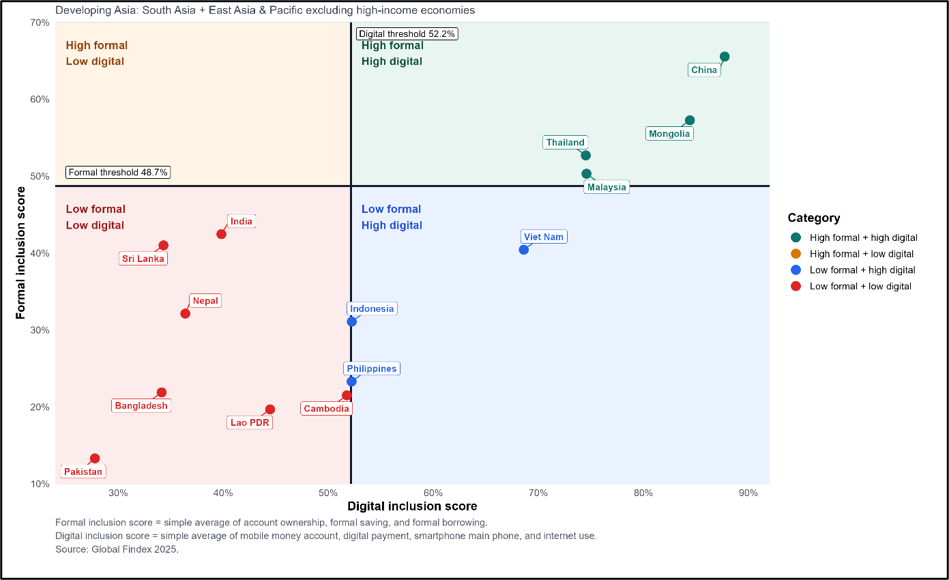
AI can support financial inclusion by acting on three complementary dimensions: access, usage and quality, thus contributing to financial health in developing Asian countries. However, AI will not generate the same benefits across all developing Asian economies which are highly heterogeneous (Figure 1). Some countries already have high account ownership and advanced payment infrastructure but still face limited effective usage or consumer protection challenges. Others have strong mobile and digital adoption but weaker formal financial access. In lower-income or more remote contexts, the basic prerequisites for AI-enabled finance – connectivity, smartphones, digital ID, reliable electricity, etc. – may still be missing.
AI can improve access by making onboarding cheaper, faster and more scalable. Many excluded users face practical barriers to entering the formal financial system: lack of formal document, distance from branches, high customer-acquisition costs, low literacy, or inability to navigate complex digital interfaces. AI can reduce some of these barriers through e-KYC, document recognition, biometric verification, automated customer support, translation and voice interfaces. In Southeast Asia, the linguistic dimension is particularly important. Initiatives such as SEA-LION2, and broader efforts such as SEACrowd3, respond to the fact that many global AI models underrepresent Southeast Asian languages and contexts. These local-language and voice-based interfaces can make digital finance more accessible to low-literacy users, elderly people and rural communities, thus improving financial inclusion.
AI can also improve usage by reducing information asymmetries, simplifying and tailoring financial products to customer’s needs. Many households, informal workers and SMEs in Asia remain excluded from formal credit because they lack collateral, formal proof of income, audited accounts or conventional credit histories. AI can be particularly useful here by helping with credit scoring. Machine-learning models can process large volumes of structured and unstructured data, identify non-linear patterns in repayment behavior, and transform dispersed digital traces into credit-relevant signals (Berg et al., 2020; Agarwal et al., 2020; AFI, 2025). AI can also support usage through personalized nudges: saving reminders, repayment alerts, budgeting prompts or transaction summaries. Karlan et al. (2016) show, including through evidence from the Philippines, that reminders can increase the likelihood of meeting savings goals.
Finally, AI can improve the quality of financial inclusion by strengthening financial education, consumer protection and supervision. AI-powered financial education can provide personalized explanations, local-language guidance and practical support on savings, credit, insurance, fraud prevention and data protection. AI can also help protect consumers by detecting scams, abnormal transactions, hidden fees, aggressive lending practices or complaint patterns. For supervisors, AI-based SupTech tools can analyze consumer complaints, identify fraud networks, map risks by institution or location, and detect misconduct earlier (BIS, 2024; FSB, 2024; OECD, 2025). This is crucial in Asian markets where digital lending, mobile money and instant payments are expanding rapidly.
3. AI-enabled finance may also reinforce exclusion, consumer vulnerability and concentration in Asia if not properly managed
While AI can help deepen financial inclusion in Asia, it can also create new forms of risk and exclusion if deployed without appropriate safeguards. In developing Asia, these vulnerabilities are particularly important because the region combines rapid digital finance adoption, large informal sectors, persistent gender and rural gaps, and uneven digital readiness.
A first risk is algorithmic exclusion, whereby AI-based financial models may reproduce or amplify existing social, economic and digital inequalities. This risk stems both from biased proxies and from non-representative data. Even if sensitive variables are excluded, seemingly neutral indicators – such as location, phone type, transaction frequency, app usage, language, platform activity or consumption behavior – can operate as proxies for income, gender, education or rurality (Fuster et al. 2022). At the same time, the populations that AI is expected to include are often those that generate the least usable data: women may have less control over mobile phones in parts of South Asia, rural households may rely more heavily on cash, older users may be less active on app-based financial services, informal workers may have irregular income flows, MSMEs may mix household and business transactions, farmers may face seasonal income and climate shocks, migrants may use fragmented financial channels, and low-literacy users may depend on agents rather than personal apps. As a result, AI models may be less accurate precisely for underserved groups, which can translate into lower credit limits, higher prices, more false fraud alerts or rejected onboarding applications.
AI can make financial services cheaper, faster and more personalised, but it can also make harmful practices more scalable and harder to contest. While AI models can improve access to credit, they can also encourage over-borrowing, high implicit interest rates, behavioural targeting and abusive collection practices, when not generating blatant scams (e.g. voice cloning, deepfakes). For instance, AI can be used to target financially vulnerable users with aggressive credit offers, detect moments of liquidity stress, or optimise product design in ways that increase take-up without improving financial health (Ramesh et al., 2022). These risks are compounded when users have limited ability to challenge automated decisions. If an AI system rejects a loan, blocks a wallet, reduces a credit line, flags a transaction as suspicious or enables fraudulent activity, users need to understand the reason and access human review. Low-income users – for whom a blocked account or rejected emergency loan can have immediate welfare consequences – are particularly vulnerable to these practices.

These concerns may become more acute with emergence of agentic AI systems which can autonomously perform sequences of actions and interact with customers or financial infrastructure with more limited human intervention (AFI, 20264). Regulation can therefore play an important role in ensuring that greater automation does not come at the expense of accountability and consumer protection. In this regard, the EU AI Act (2024) could provide a useful benchmark for other jurisdictions in developing Asia. It adopts a risk-based approach, imposing stronger requirements where AI decisions can have major consequences for individuals, notably for systems used to assess consumer’s credit worthiness. The French Prudential Supervision and Resolution Authority (ACPR) is going a step further by translating these principles into supervisory practice, developing methodologies to assess financial institutions’ AI systems and integrating AI into its own supervisory capabilities5.
Finally, AI may deepen digital concentration and sovereignty risks. Financial institutions or regulators may rely on the same cloud providers, AI vendors, data brokers or platform ecosystems, creating operational, cyber and systemic vulnerabilities. They may become dependent on external models or foreign-hosted infrastructure that they do not fully control. This is linked to a deeper infrastructure issue where countries with limited energy supply, weak data infrastructure or low supervisory capacity may find themselves dependent on foreign providers.
4. Building the Foundations for AI-Enabled Financial Inclusion around the 3 “I”s
For AI to reshape financial inclusion across developing Asia, it needs to be built on the right foundations of Information, Infrastructure, and Incentives. Financial and digital literacy, including AI literacy, will become increasingly important as consumers rely on AI-generated recommendations and interact with AI-powered financial services. At the same time, robust digital public infrastructure, including reliable internet connectivity, smartphones, digital identity systems, fast payment systems, and interoperable data-sharing frameworks, remains essential to ensure that AI-enabled financial services are accessible to all segments of society. Finally, carefully designed incentives can accelerate behavioural change and encourage both consumers and merchants to adopt AI digital financial services.
- Governments have a critical role in building these foundations. Beyond investing in digital public infrastructure, governments should continue promoting financial and digital literacy while integrating AI literacy into national education and consumer awareness programmes. They can also encourage digital financial adoption through well-designed public policies and incentive schemes, particularly for underserved populations and small businesses. Experiences from countries such as Thailand, India, Indonesia, and the Philippines show that linking government transfers, subsidies, and social assistance to digital payment channels has encouraged millions of people to open and actively use formal financial accounts. Combined with AI-enabled financial services, such policies can accelerate financial inclusion and promote sustained adoption of digital finance.
- Central banks and financial supervisors play a vital role in ensuring that AI supports a safe, inclusive, and trustworthy financial system. They should strengthen regulatory frameworks for responsible AI while leveraging AI-powered supervisory technology (SupTech) to improve financial inclusion. SupTech can help authorities analyze large datasets, identify underserved populations, detect fraud and consumer risks, and enhance supervisory efficiency. Regulatory sandboxes and innovation hubs can further support responsible innovation. The Reserve Bank of India’s FREE-AI Committee is one example of how central banks are preparing for the AI era (CGAP, 20256)
- Financial institutions and payment service providers are ultimately responsible for translating AI into better financial services for consumers. Beyond improving operational efficiency, AI should be used to empower users by providing personalized financial education, budgeting advice, fraud warnings, savings reminders, and explanations of financial products in local languages. AI-powered assistants can help customers better understand borrowing decisions, improve financial planning, recognize scams, and build long-term financial capability. In this way, AI becomes not only a tool for selling financial products but also a trusted companion for improving financial well-being.
Ultimately, AI should be viewed as a policy enabler rather than an end in itself. Success will depend on close collaboration among governments, central banks, financial institutions, and technology providers to build the right information, infrastructure, and incentives. When these foundations are in place, AI can become a powerful catalyst for expanding financial inclusion, strengthening financial capability, and improving financial well-being across developing Asia.
- In this note, “developing Asia” refers to South and East Asie & Pacific excluding high-income economies, consistent with the Global Findex regional aggregates used here. ↩︎
- SEA-LION, or Southeast Asian Languages in One Network, is a family of open-source multilingual language models developed by AI Singapore to better represent Southeast Asian languages, cultures and contexts, particularly under-represented and low-resource languages. See : https://sea-lion.ai/ ↩︎
- SEACrowd is a community-led initiative that develops and catalogues datasets, benchmarks and other AI resources for Southeast Asian languages and cultural contexts. Its work seeks to strengthen locally grounded AI research and improve the representation of the region’s linguistic diversity. See: https://seacrowd.org/ ↩︎
- From Reflection to Agency: Supervising AI in Finance – Alliance for Financial Inclusion ↩︎
- Implementing effective surveillance of AI in the financial sector | Banque de France ↩︎
- CGAP. (2025). AI-Powered SupTech for Financial Inclusion: How Emerging Market Authorities Can Unlock Its Potential. Consultative Group to Assist the Poor (CGAP). ↩︎