
The relationship between artificial intelligence (AI), productivity, and inflation is complex and multifaceted. AI adoption is expected to significantly raise productivity, therefore increasing aggregate output in the long run. However, AI-related spending could increase consumption and investment even before productivity gains materialized. Inflation responses to AI adoption also depends on the expectations of households and firms regarding the transformative potential of AI and their readiness to act on these expectations. The net effect of AI on inflation dynamics hinges on the timing and magnitude of both supply and demand side forces, which in turn interacts with households’ and firms’ expectations and behaviors.

Park and Shin (2026) examine whether the early diffusion of AI in Korea is affecting productivity and inflation outcomes. To do so, we constructed (a) the value-added-weighted and (b) the employment-weighted measures of AI intensity, using firm-level AI-adoption data. These measures are combined with industry- and region-level panels for 2017–2023 to analyze the annual outcomes across both industries and regions. Key findings of the paper are as follows. First, AI intensity was highly uneven across industries and regions and remained persistent over time: 2019 AI intensity strongly predicted the cross-sectional distribution of AI intensity in 2023. Second, high AI-intensity at either industry or region level did not lead to systematically strong output or labor productivity growth in 2023. Third, there is no robust evidence that AI intensity exerted influence on industry level inflation. Fourth, regional price results are more suggestive (See Table 5): employment-weighted AI intensity is associated with higher total CPI inflation, and restaurant-price inflation is higher under both value-added- and employment-weighted measures of AI-intensity.
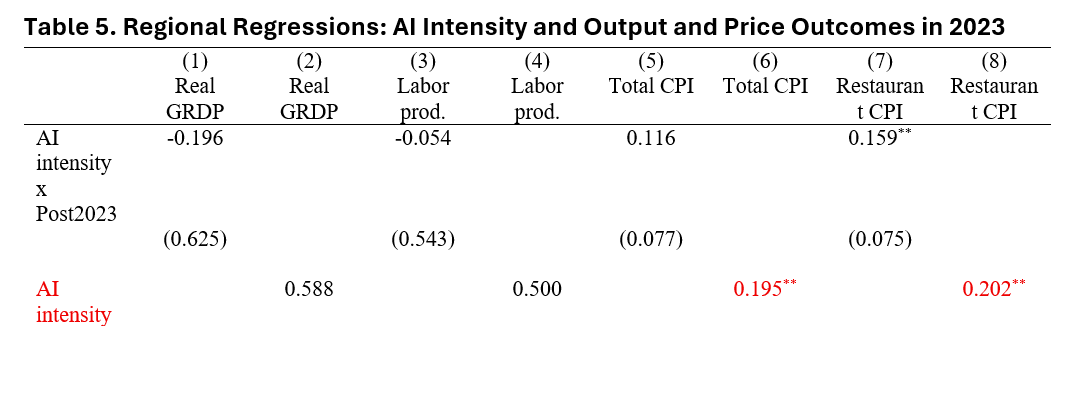
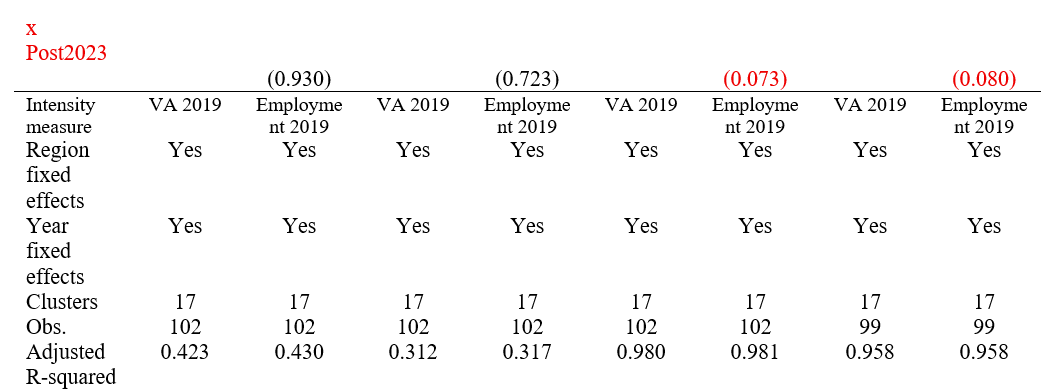
Note: The dependent variables are annual log changes multiplied by 100. The national aggregate is excluded from all regional regressions. The baseline intensity measure is value-added-weighted AI intensity in 2019; employment-weighted AI intensity is reported as an alternative measure. All intensity measures are standardized at the regional level before estimation. All specifications include region and year fixed effects. Standard errors clustered at the regional level are reported in parentheses. ***, **, and * denote statistical significance at the 1%, 5%, and 10% levels, respectively.
Source: Authors’ calculations.
The results are aligned with a growing literature that treats AI as a general-purpose technology whose macroeconomic effects depend on timing, expectations, and complementary investment. The productivity J-curve literature emphasizes that measured productivity may initially respond weakly because firms must first reorganize workflows, train workers, build data systems, and accumulate intangible capital. Recent macroeconomic work on AI similarly shows that productivity gains can raise output in the long run, but that inflation may rise in the transition if households and firms anticipate future income gains and if investment demand expands before supply capacity catches up. This helps reconcile the paper’s finding of limited productivity gains in 2023 with positive regional price effects.
In the early adoption phase, AI intensive firms and regions may face rising demand for scarce complementary inputs, including specialized labor, cloud services, semiconductors, data center capacity, electricity, consulting, and software integration. These expenditures can raise local income and business costs before efficiency gains are fully realized. If the additional income is spent on locally supplied services, such as restaurants and personal services, prices can rise in categories with limited short run capacity. AI may also affect pricing behavior directly by enabling faster repricing, better demand forecasting, and more granular price discrimination, potentially strengthening pass-through in some markets.
Over time, the balance should depend on whether AI diffusion produces broad, measurable productivity gains that exceed the resource costs of adoption. If complementary investments mature and AI becomes embedded in production processes, unit labor costs may fall, supply capacity may expand, and inflationary pressure could ease. However, this disinflationary effect is not automatic. Persistent demand for computing infrastructure, energy, and high-skill labor could keep some input prices elevated, while uneven adoption may create sectoral bottlenecks and relative price pressures. The long run outcome is therefore likely to be heterogeneous: disinflation in activities where AI materially lowers marginal costs, but ongoing inflationary pressure where AI raises demand for constrained inputs or services.
Central banks should avoid treating anticipated AI productivity gains as realized supply improvements. In the near term, AI diffusion may generate demand side and cost side inflation through investment, infrastructure, energy use, and skilled labor demand. Monetary-policy assessments should therefore separate expected long-run productivity effects from observed short run price dynamics; monitor regional CPI, service prices, producer prices for AI related inputs, electricity and data center indicators, and wage pressures in AI exposed occupations; and incorporate wider confidence bands around potential output and inflation forecasts. In the longer run, if AI raises trend productivity and potential output, neutral interest rates and the appropriate policy stance may also shift, requiring continual reassessment rather than one-off forecast adjustments.
The early evidence from Korea suggests that AI’s productivity benefits had not yet materialized in aggregate indicators by 2023, while some inflationary pressures were already visible at the regional consumer price level. For monetary policy, the key risk is treating anticipated AI supply gains as if they had already arrived.