

Author’s note: This blog is based on a published article: Bratsiotis, G.J. and Pathirage, K.D. (2026), ‘Monetary and Macroprudential Policy and Welfare in an Estimated Four-Agent New Keynesian Model’, Journal of Money, Credit and Banking, 58(5), pp. 1411-1452. https://doi.org/10.1111/jmcb.13095. The views expressed in this blog are those of the authors and do not necessarily represent the views of their corresponding institutional affiliations.
Macroprudential policy improves financial resilience, but its welfare effects need not be shared equally. Deposit-holding households, underbanked households, firms dependent on bank credit and bank owners can be affected differently by the same requirement. Aggregate welfare can therefore conceal who bears the costs and who receives the benefits.
Our recent research examines these differences in a four-agent New Keynesian DSGE model (see Bratsiotis and Pathirage, 2026). The model combines Bayesian estimation using U.S. quarterly data with calibration of selected parameters. It illustrates economically plausible trade-offs of macroprudential policy and provides quantitative estimates conditional on its structure and the data used for estimation and calibration.
Why distinguish different agents?
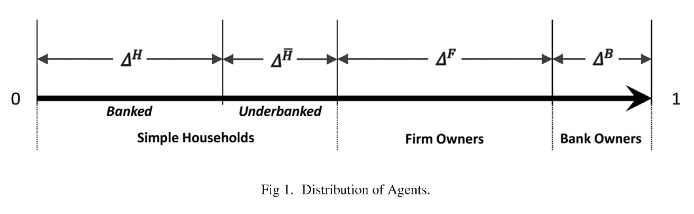
The model separates banked simple households, who have access to savings in the form of deposits but do not have other investments; underbanked simple households, who are non-Ricardian type consumers who do not have access to financial markets; firm owners, who are owners of non-financial firms; and bank owners, who own financial institutions (Fig 1). This goes beyond the usual borrower–saver distinction widely used in structural macro-financial models (see, among many others, Iacoviello, 2005; Gerali et al., 2010). These groups differ in their access to deposits, financial markets, bank credit and bank capital, and therefore in their exposure to prudential policy.
This separation is important because stronger capital can reduce bank default risk while affecting lending conditions, whereas loan-loss provisions absorb future losses by reserving resources that could otherwise support current lending.
Macroprudential buffers: resilience comes with trade-offs
The model allows both entrepreneurs and banks to default. Structural capital requirements and loan-loss provisions can therefore be examined through financial-resilience and real-economy channels, with welfare evaluated separately across agents.
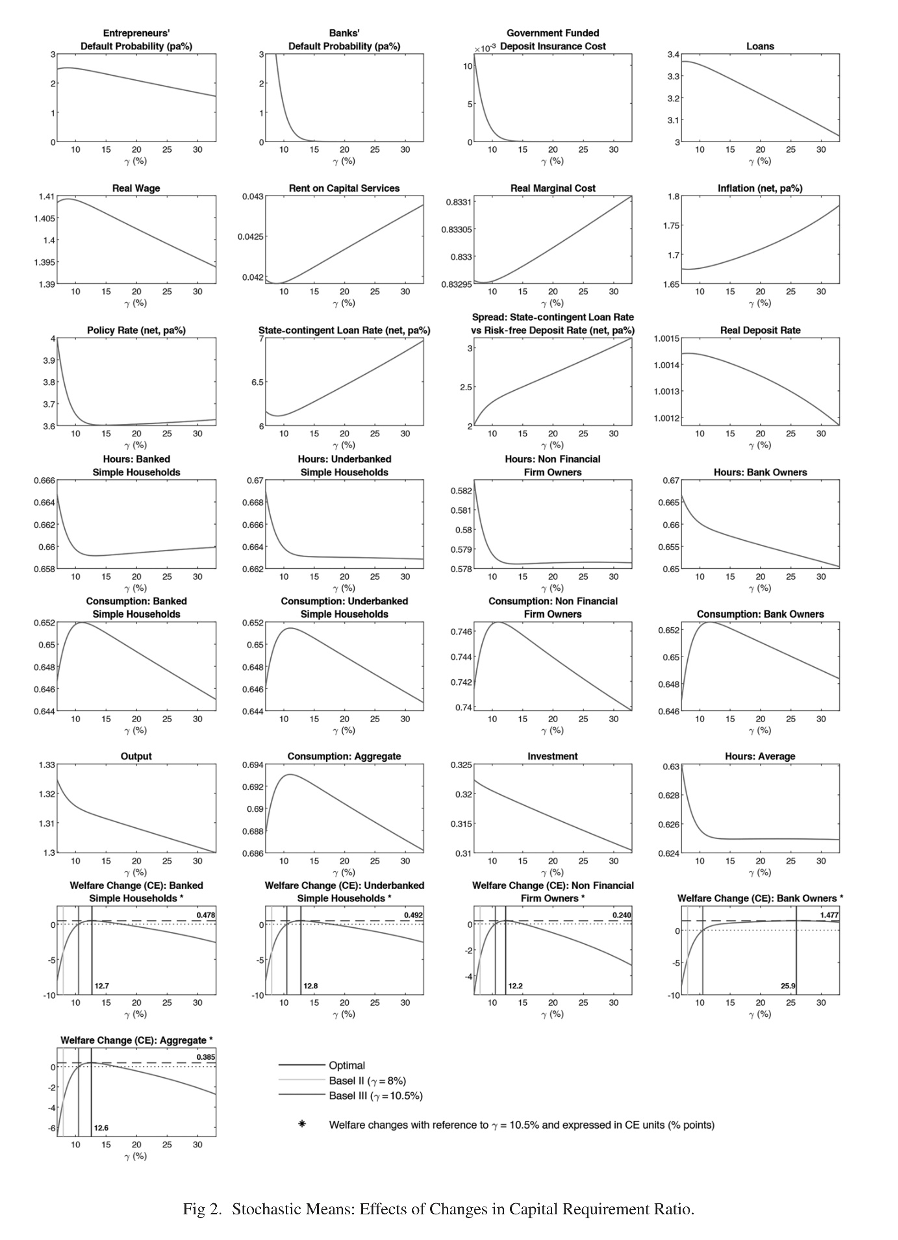
For bank capital requirements, the model produces a social optimum of 12.6%, compared with the 10.5% benchmark used in the paper. It is shown that increasing required bank capital reduces bank default risk and expected deposit-insurance costs. However, as requirements become more stringent, higher loan spreads and weaker investment increasingly offset these gains (Bratsiotis and Pathirage, 2026). Accordingly, the more transferable result is the resilience–credit trade-off associated with bank capital requirements, consistent with the broader literature (see, among others, Clerc et al., 2015; Mendicino et al., 2018), while the precise numerical location of the welfare maximum is more model-specific.
The same policy can affect agents differently
The welfare trade-off differs across agents. Firm owners prefer a lower capital ratio because they depend on bank credit. Meanwhile, bank owners prefer relatively higher capital ratios, because higher capitalisation reduces default risk and increases the role for bank capital. However, at sufficiently high requirements, weaker lending and activity eventually dominate. (Fig 2) The result highlights how welfare effects could depend on income sources and financial exposure.
Loan-loss provisions generate a related but different mechanism. The model’s social optimum is 6.3%, well above the U.S. sample-period average, although the precise optimum is model-contingent. Provisions lower risk by reserving resources against expected losses. On the other hand, capital requirements can be met through additional bank capital. The instruments therefore affect lending through different channels.
Countercyclical tools: the shock matters
The cyclical exercises show that instruments add most when their transmission channel matches the disturbance. In the model, countercyclical capital buffers (CCyBs) contribute most following productivity and credit-risk shocks, while for several other shocks optimised monetary policy already provides much of the stabilisation (Bratsiotis and Pathirage, 2026, Table 5). Although the exact welfare rankings depend on the model and calibration, the broader point is that CCyB usefulness depends on the vulnerability through which the shock reaches the financial system. The model also evaluates dynamic loan-loss provisioning, which is found to be useful mainly when shocks affect firms’ repayment capacity.
Coordination may yield higher welfare
The paper also compares coordinated and non-coordinated monetary and macroprudential policy. Under coordination, the interest-rate rule and the macroprudential response are chosen jointly to maximise social welfare. Under non-coordination, each authority is assumed to optimise its own independent objective. For the CCyB exercise, this specific set-up produces higher aggregate welfare under coordination than under non-coordination, thus aligning with similar findings in the literature (see, among others, Angelini, Neri and Panetta, 2014; Paoli and Paustian, 2017). However, coordination is not Pareto superior, as firm and bank owners can obtain larger welfare gains under non-coordination.
Insights for SEACEN economies
The model’s regional relevance lies in the framework it provides for analysing financial structure, instrument choice and heterogeneous welfare effects.
One main takeaway is that the financial structure matters for shaping how economic costs and benefits of macroprudential policy are distributed across different groups. Differences in financial inclusion, deposit holdings and firms’ reliance on bank credit can alter who benefits from stronger prudential buffers and who bears the cost.
These results also suggest that instrument choice should reflect domestic vulnerabilities. Bank capital, provisioning and cyclical tools operate through different channels. Thus, country-specific calibration, stress testing and scenario analysis are preferable to transferring numerical ratios from another economy.
Further, the findings also speak to the importance of explicitly assessing the interaction between monetary and macroprudential policies. The model illustrates potential welfare gains from coordination under the particular policy objectives assumed, although the appropriate arrangements will need to depend on institutional mandates and domestic economic structures.
References
Angelini, P., Neri, S. and Panetta, F. (2014) ‘The Interaction between Capital Requirements and Monetary Policy’, Journal of Money, Credit and Banking, 46(6), pp. 1073–1112. Available at: https://doi.org/10.1111/jmcb.12134.
Bratsiotis, G.J. and Pathirage, K.D. (2026) ‘Monetary and Macroprudential Policy and Welfare in an Estimated Four-Agent New Keynesian Model’, Journal of Money, Credit and Banking, 58(5), pp. 1411–1452. Available at: https://doi.org/10.1111/jmcb.13095.
Clerc, L., Derviz, A., Mendicino, C., Moyen, S., Nikolov, K., Stracca, L., Suarez, J. and Vardoulakish, A.P. (2015) ‘Capital regulation in a macroeconomic model with three layers of default’, International Journal of Central Banking, 11(3), pp. 9–63. Available at: https://www.ijcb.org/journal/v11n3/capital-regulation-macroeconomic-model-three-layers-default.
Gerali, A., Neri, S., Sessa, L. and Signoretti, F.M. (2010) ‘Credit and Banking in a DSGE Model of the Euro Area’, Journal of Money, Credit and Banking, 42(s1), pp. 107–141. Available at: https://doi.org/10.1111/j.1538-4616.2010.00331.x.
Iacoviello, M. (2005) ‘House Prices, Borrowing Constraints, and Monetary Policy in the Business Cycle’, American Economic Review, 95(3), pp. 739–764. Available at: https://doi.org/10.1257/0002828054201477.
Mendicino, C., Nikolov, K., Suarez, J. and Supera, D. (2018) ‘Optimal Dynamic Capital Requirements’, Journal of Money, Credit and Banking, 50(6), pp. 1271–1297. Available at: https://doi.org/10.1111/jmcb.12490.
Paoli, B.D. and Paustian, M. (2017) ‘Coordinating Monetary and Macroprudential Policies’, Journal of Money, Credit and Banking, 49(2–3), pp. 319–349. Available at: https://doi.org/10.1111/jmcb.12381.